
A commercial roof does more than cover a building. It protects inventory, equipment, employees, tenants, and the day-to-day work that keeps your business moving. When a low-slope roof starts leaking or reaching the end of its service life, the silicone roofing vs TPO decision can affect your budget, downtime, and long-term maintenance.
Both systems can be excellent choices. The right answer depends on what is already on your roof, how much ponding water you have, the condition of the insulation and deck, and whether a restoration can safely replace a full tear-off. A clear inspection comes before a material recommendation.
Silicone Roofing vs TPO: The Main Difference
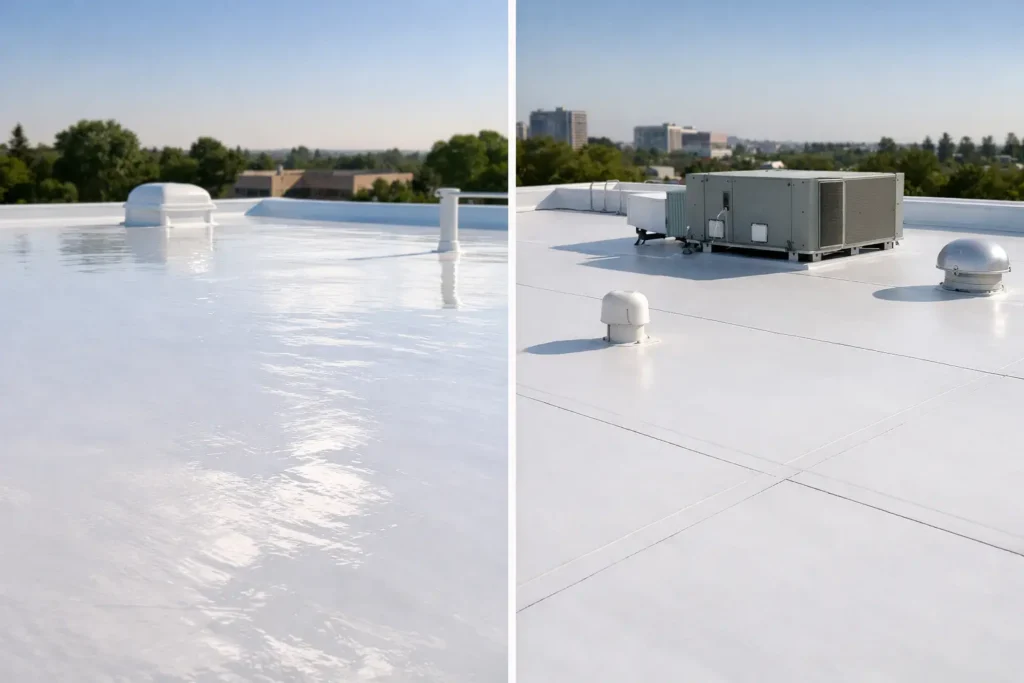
TPO is a single-ply roofing membrane installed in sheets. It is mechanically attached, adhered, or sometimes ballasted over an approved roof assembly. Seams are heat-welded to create a continuous waterproof surface. On a new commercial roof or a full reroof, TPO is one of the most common systems because it is dependable, reflective, and widely available.
Silicone roofing is a fluid-applied coating system. A qualified crew cleans and prepares the existing roof, repairs problem areas, reinforces seams and penetrations where needed, and applies silicone coating at the specified thickness. Once cured, it forms a monolithic membrane over the roof surface.
That difference matters. TPO is generally a replacement roof system. Silicone is often a restoration option for an existing roof that is still structurally sound. If the roof deck is deteriorated, insulation is saturated, or the existing membrane is too far gone, a coating may only cover a larger issue. In that case, TPO or another replacement system may be the responsible recommendation.
When Silicone Roofing Makes Sense
Silicone can be a strong option for commercial property owners who have an aging low-slope roof but want to avoid the cost, disruption, and landfill waste of a tear-off. Because the system is applied over an eligible existing roof, the installation process can be less invasive than a full replacement.
Its biggest advantage is resistance to standing water. East Texas storms can leave water on low areas long after the rain stops. Silicone holds up well under ponding water, while some other coatings can soften or lose adhesion when water sits for extended periods. That does not mean drainage should be ignored. Drains, scuppers, gutters, and roof slope still need attention, but silicone is more forgiving when water cannot leave immediately.
Silicone coatings are also highly reflective, typically white, which can reduce heat absorption on roofs exposed to long summer sun. The actual energy benefit varies with insulation levels, building use, HVAC demand, and the condition of the roof below. It should be viewed as one part of an energy plan, not a guaranteed utility-bill fix.
A silicone restoration may be especially attractive when the existing roof has minor leaks at seams, penetrations, or flashing details but has dry insulation and a sound deck. The coating creates a continuous surface without the many seams found in sheet systems. Less demolition can also mean less disruption to occupied offices, retail spaces, churches, warehouses, and multifamily properties.
The trade-off is preparation. Silicone only performs as well as the surface beneath it. The roof must be cleaned thoroughly, damaged areas must be repaired, moisture must be addressed, and the coating must be applied at the correct thickness. A low bid that skips prep work is not a bargain if the coating fails to bond.
When TPO Is the Better Choice
TPO is often the smarter choice when a building needs a true replacement roof. If core samples or moisture scans show wet insulation, compromised decking, widespread membrane failure, or multiple layers that should be removed, coating over the roof is not a long-term repair. The damaged materials need to come out.
A new TPO system gives the contractor an opportunity to inspect and repair the roof deck, replace insulation, improve drainage design where practical, and build a complete roofing assembly. That can be a major advantage for properties with recurring leaks, storm-related damage, or old roofs that have been patched repeatedly.
TPO also provides a familiar, proven system for large commercial roofs. Its heat-welded seams are a major strength when installed correctly. The membrane resists ultraviolet exposure and is commonly available in white for solar reflectivity. It can be detailed around rooftop equipment, curbs, pipes, and edges with manufacturer-approved accessories.
Still, TPO is not automatically the best option just because it is popular. A full replacement usually costs more upfront than a restoration, takes longer, and creates more jobsite activity. Existing materials may need to be removed and disposed of, and interior operations may require additional protection during tear-off. For a roof that is otherwise dry and stable, that level of work may not be necessary.
Cost, Service Life, and Maintenance
The initial price difference often drives this conversation, but price should not be the only deciding factor. Silicone restoration is usually less expensive than a complete TPO replacement because it can avoid tear-off costs and shorten installation time. That savings is real only when the current roof qualifies for restoration.
TPO typically involves more material and labor because it is a full roofing assembly or replacement membrane. It may cost more at the beginning, but it can address hidden problems that a coating cannot solve. If your insulation is wet, choosing a cheaper coating route could lead to more expense when leaks and deterioration continue beneath it.
Both systems require maintenance. Roofs are not install-it-and-forget-it building components. Keep drains clear, remove debris, inspect flashing, watch for damage around HVAC equipment, and schedule a professional inspection after severe weather. Small punctures, open details, and backed-up drainage are easier and less costly to handle early.
Silicone roofs can often be renewed later with an additional coating application if the underlying roof remains sound. TPO repairs usually involve cleaning the area and welding a compatible patch over damage. Neither repair approach is difficult for a trained commercial roofing crew, but both depend on finding problems before water reaches insulation or the deck.
How East Texas Weather Affects the Choice
Commercial roofs around Tyler face heavy rain, strong winds, hail, intense sunlight, humidity, and rapid weather changes. No material makes a roof storm-proof. Proper fastening, flashing, drainage, edge metal, and installation quality matter as much as the membrane itself.
Silicone earns attention here because of its performance around ponding water and its ability to seal many roof details into one coated surface. It can be a practical solution for an existing low-slope roof that remains structurally healthy after years of sun and rain.
TPO is often preferable after major storm damage or when inspection reveals moisture below the existing membrane. A new system allows the roofing contractor to remove damaged layers instead of trapping moisture in place. For buildings with exposed locations or complex rooftop equipment, a properly designed TPO assembly may also provide a clean, durable path forward.
Start With a Roof Assessment, Not a Sales Pitch
The best material is the one that addresses the actual condition of your building. Before choosing silicone or TPO, ask for an inspection that evaluates the membrane, seams, flashing, drainage, insulation, deck condition, and signs of trapped moisture. Photos, moisture findings, and a clear scope of work should be part of the conversation.
Ask whether restoration is truly appropriate, what preparation work is included, how penetrations and drains will be handled, and what warranty coverage applies. If a contractor recommends TPO, ask what must be removed, whether insulation will be replaced, and how the crew will protect your operations during the work.
Spartan Exteriors helps commercial property owners make that call without pushing a one-size-fits-all answer. A roof that can be restored should not be torn off without a reason, and a roof with concealed moisture should not be coated simply to make the first price look better.
Your building deserves a roof plan based on facts, not assumptions. Schedule an assessment before the next leak becomes interior damage, and choose the system that protects the property for the work ahead.