
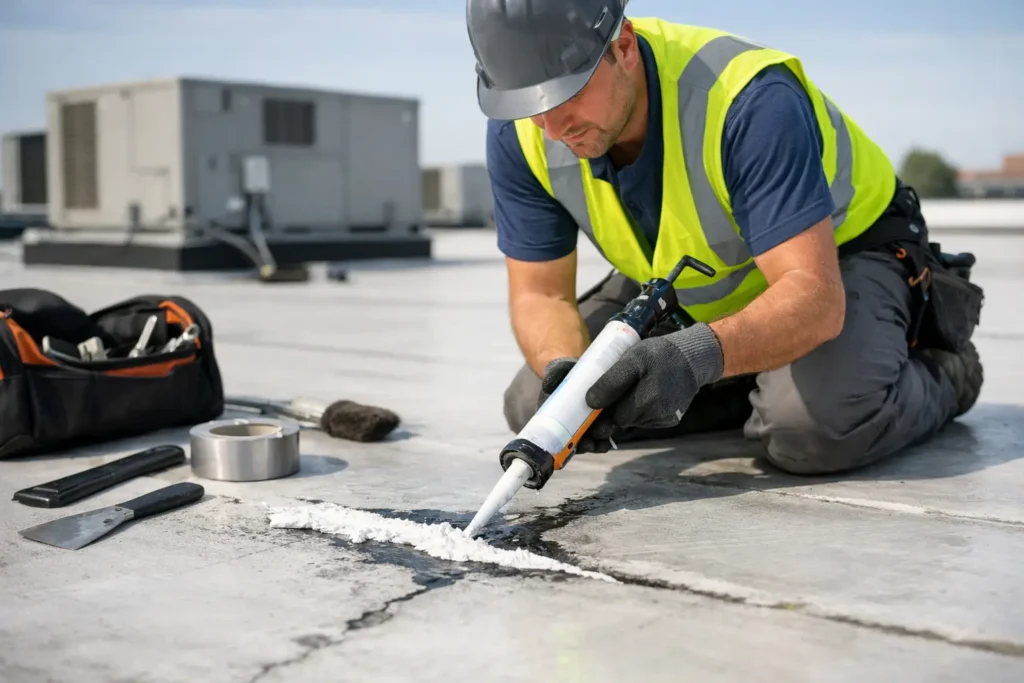
A commercial roof leak rarely starts as a small problem for long. One stained ceiling tile can turn into damaged insulation, ruined inventory, mold concerns, electrical risk, and an unhappy tenant or staff. That is why commercial roof leak repair needs to be handled with urgency, but also with good judgment. A fast patch is not always a real fix, and waiting too long usually makes the repair more expensive.
For business owners and property managers, the real challenge is not just stopping water today. It is figuring out why the roof leaked, how far the damage spread, and whether the repair you pay for now will still be doing its job after the next hard East Texas storm.
What makes commercial roof leaks tricky
Commercial roofs are different from most residential systems in one important way. Water can travel a long distance before it shows up inside the building. The spot where you see the drip may be several feet away from the actual failure point on the roof.
That is why leak repair on a commercial property should start with inspection, not guesswork. Flat and low-slope roofs often have multiple vulnerable areas working together. Seams can separate. Flashing can pull away around HVAC units or parapet walls. Drains can back up. Older coatings can wear thin. A roof may also have storm damage that is not obvious from the ground.
On top of that, many commercial buildings already have a repair history. One section may have been patched three times with three different materials. Another area may have ponding water that was never corrected. When layers of temporary work start stacking up, a leak can be harder to trace and easier to misdiagnose.
Commercial roof leak repair starts with the right diagnosis
A good repair plan depends on the roof type, the age of the system, and the condition of the surrounding areas. The right fix for a metal roof is not the right fix for a modified bitumen roof, and neither should be approached the same way as a silicone-coated commercial roof.
For example, a leak around a rooftop penetration might be solved by replacing failed flashing and resealing the detail. But if that same penetration sits in an area where the substrate has softened from long-term moisture, sealing alone will not hold. The damaged section may need to be removed and rebuilt before the roof can be properly watertight again.
This is where experience matters. You want a contractor who can tell the difference between a true source of leakage and a symptom. If a repair crew treats every leak as a simple sealant job, the building owner often ends up paying twice.
Common sources of commercial roof leaks
Most commercial roof leaks come from a handful of repeat trouble spots. Penetrations are a major one, especially around vents, skylights, curbs, and mechanical equipment. Seams and laps are another frequent issue, particularly on aging membrane systems. Flashing failures at walls and edges are common after wind events. On metal roofs, exposed fasteners, backed-out screws, panel movement, and deteriorated sealant can all open the door to water intrusion.
Drainage problems also deserve attention. A roof that holds standing water is under constant stress. Ponding does not automatically mean the roof will fail right away, but it shortens the life of materials and raises the odds that weak spots will turn into leaks.
When a patch is enough and when it is not
Sometimes a targeted repair is exactly the right move. If the roof is generally in good shape and the leak is tied to an isolated failure, a professional repair can add meaningful life to the system. That is often the most cost-effective option for a newer commercial roof or one that has been maintained well.
But there are times when repeated repair is the more expensive choice. If leaks are showing up in multiple areas, if the roof assembly is saturated, or if the membrane is near the end of its service life, patching one section at a time may only delay a larger problem. In those cases, the honest answer might be partial replacement, restorative coating, or full reroofing.
That can be frustrating to hear when you called about one leak. Still, a trustworthy contractor should tell you what the roof actually needs, not just what sounds easier in the moment. Business owners deserve a clear scope, realistic pricing, and a repair strategy that fits the condition of the building.
What to expect during commercial roof leak repair
The first step is locating the leak source and evaluating how much damage has occurred. That often includes checking the roof surface, penetrations, seams, flashings, drainage paths, and the interior signs of moisture. In some cases, the visible leak is only part of the story.
Once the source is confirmed, the repair method should match the roof system. That may involve replacing wet insulation, reinforcing seams, repairing flashing, tightening and sealing fasteners, applying compatible roof coating, or replacing damaged sections of membrane or metal panels. Compatibility matters. Using the wrong repair material can create adhesion problems and shorten the life of the fix.
After the repair, the area should be checked carefully, especially around transitions and details. Commercial roofs fail at edges, joints, and penetrations more often than they fail in the open field. The work is only as good as those finishing details.
Emergency repairs versus permanent repairs
There is a difference between stopping active water intrusion and solving the root problem for the long term. Emergency work is often necessary after a storm, fallen debris, or sudden failure. The priority is protecting the building, occupants, and contents.
That emergency response may include temporary sealing, tarping, water diversion, or isolating the damaged area until conditions allow for proper repair. There is nothing wrong with that approach as long as everyone is clear about what is temporary and what still needs to happen next. Trouble starts when a short-term measure gets treated like a permanent solution.
For East Texas properties, that distinction matters. Heavy rain, wind, and severe weather can expose weaknesses fast. A quick response protects the asset, but follow-through is what protects the investment.
How to reduce business disruption during repairs
One concern many owners have is whether roof work will interfere with operations. The answer depends on the leak location, the type of building, and the repair scope. Some repairs can be handled with very little interruption. Others, especially where interior moisture damage or active mechanical areas are involved, may require tighter coordination.
Good communication goes a long way here. A professional contractor should explain access needs, safety precautions, expected noise, and any scheduling recommendations. On occupied buildings, planning matters almost as much as the repair itself. Tenants, employees, customers, and equipment all need to be considered.
This is one reason local responsiveness matters. In communities around Tyler and across East Texas, business owners often need more than labor. They need someone who can move quickly, explain the problem clearly, and help them make practical decisions without creating more confusion.
Signs your commercial roof needs more than leak repair
Some roofs tell you pretty clearly that a single repair is not enough. If interior leaks keep reappearing in different places, if you notice blistering, open seams, rust, chronic ponding, or soft spots underfoot, the roof may be signaling broader failure. Rising energy bills can also point to wet insulation and reduced thermal performance.
Age matters too, but it is not the only factor. A well-installed roof with proper maintenance may outlast expectations. A poorly detailed roof may develop serious issues much earlier. That is why roof decisions should be based on condition, not just the calendar.
In some cases, a restoration system such as silicone roofing makes sense for a commercial building. In others, replacement is the smarter move. It depends on the substrate, the amount of trapped moisture, the drainage profile, and the owner’s long-term plans for the property.
Choosing the right contractor for commercial roof leak repair
Not every roofer is equipped for commercial leak diagnostics. You want a contractor who understands commercial systems, responds quickly, documents conditions clearly, and gives you honest options. If insurance is part of the situation, it also helps to work with a team that can provide organized damage information and communicate clearly about scope.
The best contractors do not hide behind vague language. They explain what failed, why it failed, what can be repaired, and where the limits are. They also stand behind their workmanship. That level of accountability matters when you are protecting a business, not just fixing a drip.
Spartan Exteriors takes that approach seriously because property owners need more than a temporary patch. They need straight answers, skilled repair work, and a team that treats urgency like it matters.
If your building is showing signs of active leakage, the smartest move is usually the fastest one. Get the roof inspected, get the source identified, and make sure the repair plan is built to last through the next storm, not just the next rain.